Franchise SEO Case Study: How Local Search Visibility Increased Organic Visitors by 82%
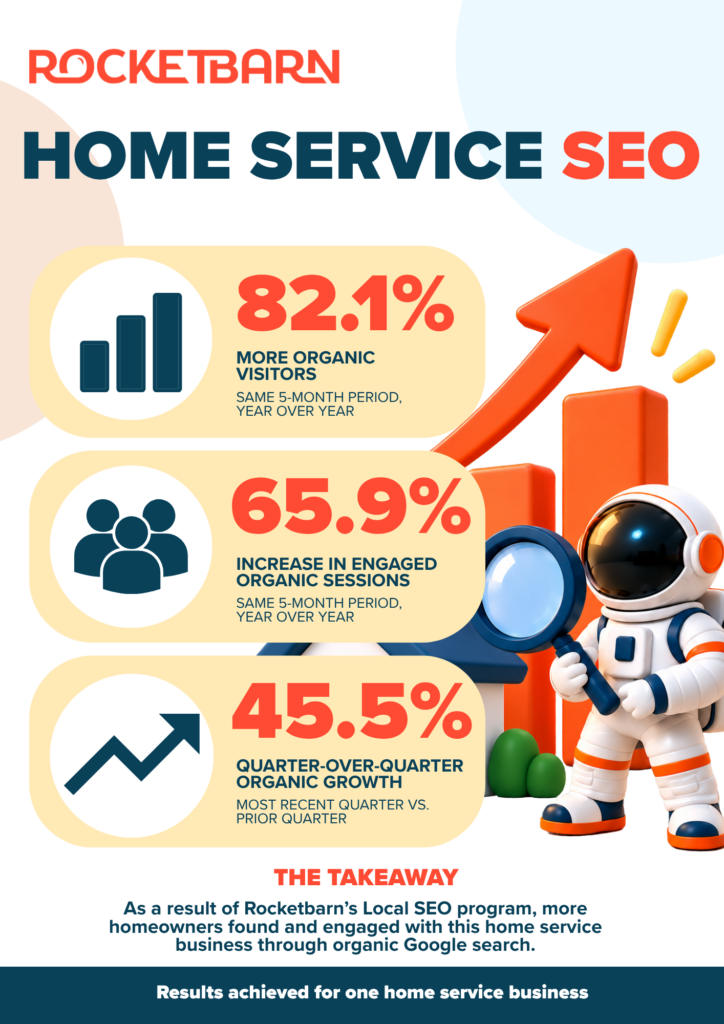
Rocketbarn helped one location within a home service franchise increase organic visitors by 82.1% year over year. The five-month comparison also showed 65.9% more engaged organic sessions, an engagement rate increase from 68.1% to 84.9%, and 12 verified website enquiries. The strategy combined localized website content, service-area optimization, lead tracking and regular collaboration between the franchisee, Franchise Marketing Advisor and SEO team.
Franchise SEO works best when the authority of the brand supports the local relevance of each location.
A corporate website may carry authority, but customers still search for providers that understand their needs and serve their community. Search engines and AI platforms need clear evidence connecting the brand, service, location and local expertise.
Rocketbarn recently measured the impact of this approach for a location within a home service franchise system.
Comparing the same five-month period year over year, the location generated:
- 82.1% more organic visitors
- 33.1% more organic sessions
- 65.9% more engaged organic sessions
- An increase in organic engagement rate from 68.1% to 84.9%
- 12 verified customer enquiries through the website
These results came without an increase in advertising spend behind the organic traffic.
The Organic Search Results
We compared Google organic search performance from April 1 through August 31 in consecutive years using the location’s Google Analytics 4 property.
| Metric | Before | After | Change |
|---|---|---|---|
| Organic visitors | 335 | 610 | +82.1% |
| Organic sessions | 602 | 801 | +33.1% |
| Engaged organic sessions | 410 | 680 | +65.9% |
| Organic engagement rate | 68.1% | 84.9% | +16.8 percentage points |
Traffic alone is not the goal. More people reached the website, but the more important result was that a larger percentage stayed, read the content or continued through the site.
That combination matters. Poorly targeted traffic can make an SEO report look better without creating value for the local business. In this case, traffic volume and visitor engagement improved together.
Local SEO Momentum Continued to Build
The year-over-year comparison was not driven by a single short-lived increase.
During the two most recent measured quarters, organic sessions increased from 389 to 566. That represented another 45.5% increase from one quarter to the next.
Search rankings will fluctuate, especially in local markets. A strong franchise SEO strategy creates more ways for qualified customers to find the business instead of relying on a few rankings or one corporate page.
Stronger Visibility Across Google Search and Google Maps
We tracked eight commercially relevant local search terms across traditional Google results and Google Maps.
Of the 16 resulting keyword and search-surface combinations:
- 15 were ranking
- 13 were in the top three
- Multiple high-intent searches held the first position
- The location appeared prominently in both organic and map results
These were not broad informational searches disconnected from the company’s services. They represented the types of searches people use when actively comparing local providers.
Google states that local results are primarily influenced by relevance, distance and prominence. Accurate business information, reviews and links can all contribute to how a local business appears. You can review Google’s explanation of local ranking factors for more detail.
A franchise cannot control every factor, particularly the searcher’s location. It can improve how clearly and credibly each location is represented.
What Drove the Organic Growth?
The improvement did not come from publishing large amounts of generic content. It came from building a clearer and more useful representation of the local business.
1. The Location Page Became the Centre of the Local Strategy
The location page generated 531 organic sessions during the measured period. It ranked for valuable local searches and gave prospective customers information tied directly to their market.
A generic corporate page may explain the brand, but it rarely answers every local question. A strong location page connects the larger franchise identity with the services, geography and customer experience available in a specific community.
For search engines, this creates a clearer relationship between:
- The franchise brand
- The individual location
- The services offered
- The areas served
- The customer’s local search intent
For customers, it creates a more relevant destination than a broad national page.
2. Useful Editorial Content Captured Research Traffic
One service-comparison article generated 57 organic sessions during the season.
Those visitors were researching their options before making a purchase. Previously, the website had no relevant resource to reach them during that part of the decision.
Effective content marketing for franchises should answer real questions, explain meaningful differences and help customers make better decisions. It should not exist simply to meet a publishing schedule.
Useful content also gives search engines and large language models more evidence about the company’s services and expertise.
3. Service and Service-Area Pages Created More Entry Points
Individual service pages and nearby service-area pages began earning organic traffic of their own.
This reduced the location’s dependence on its homepage and primary location page. It also gave search engines more specific information about what the business provides and where those services are available.
Done properly, these pages reflect real service offerings and market needs. They are not copies with a city name changed.
Thin or duplicated location content may create more URLs, but it does not create more local value.
4. Local Knowledge Shaped the Strategy
Keyword data can show what people search for. Analytics can show how they interact with the website. Neither can fully explain what is happening inside the local business.
The franchisee understands the questions customers ask, which services are growing, where leads are falling short and what makes the local market different. That information helps the SEO team make better decisions about content, priorities and positioning.
At Rocketbarn, the Franchise Marketing Advisor helps maintain that connection.
The FMA works with the franchisee to understand business conditions and customer feedback, then helps connect those insights with the campaign team and broader franchise strategy. They can also bring relevant lessons from other locations back into the conversation.
This creates a practical feedback loop:
- Search and website data reveal an opportunity.
- The franchisee adds real local context.
- The FMA helps turn that context into clear marketing direction.
- The SEO team executes and measures the work.
- Useful findings can inform other locations and the franchisor.
The FMA is not a replacement for technical SEO or content expertise. Their value is ensuring the strategy remains connected to the local business instead of becoming an isolated list of marketing tasks.
5. Lead Tracking Confirmed Business Activity
The location’s WordPress form log recorded 12 genuine customer enquiries between April 1 and August 31. Internal tests were excluded.
Every enquiry was successfully delivered to the company’s call centre, with no failed handoffs during the period.
Rankings and traffic are early indicators. A franchise SEO program should also confirm that prospective customers can complete the next step and that those leads reach the local business.
What This Means for Generative Engine Optimization
Generative engine optimization, commonly called GEO, is often presented as an entirely new marketing discipline. In practice, many of its strongest foundations are also the foundations of good SEO:
- Clear information about the company and its services
- Consistent relationships between the brand and its locations
- Useful answers to real customer questions
- Specific evidence of local expertise
- Pages that are accessible and easy to understand
- Accurate business information across websites and local profiles
Large language models need reliable information to understand which businesses may be relevant to a question. A national franchise page alone may not provide enough local context.
Location pages, service pages, original articles and accurate local business information provide more evidence about who the business serves, what it does and where it operates.
Structured data can provide search engines with additional clues about the meaning of a page and the entities it describes. Google provides a useful introduction to structured data, including implementation and validation guidance.
There is no shortcut that guarantees an AI platform will mention a business. The practical strategy is to make the company easier to understand, verify and recommend.
That work also creates a better website for real customers, which remains the more important objective.
Why Franchise SEO Requires a Different Approach
Franchise systems have to serve two audiences at once.
The franchisor needs consistency, visibility and scalable processes. The franchisee needs relevant local traffic and qualified opportunities in their market.
Focusing only on the corporate website can leave individual locations invisible. Giving every location complete freedom can create inconsistent messaging, duplicated content and weak brand control.
Rocketbarn builds franchise SEO strategies around both needs. Our approach combines:
- Franchise-wide SEO direction
- Local market and keyword research
- Location-page optimization
- Service and service-area content
- Google Business Profile support
- Technical SEO
- Content based on real customer questions
- Organic traffic, engagement and lead measurement
- Dedicated FMA guidance
- Ongoing analysis across participating locations
As more locations participate, the network can create stronger benchmarks and identify patterns that would be difficult for an independent local business to see on its own.
Real Local Value Creates Better Search Visibility
The strongest local SEO does not manufacture relevance. It documents and communicates the relevance that already exists.
A local franchise owner knows the market, serves customers in the community and develops experience that can help future customers make better decisions. The website should make that value visible.
That may include:
- Services available in the market
- Communities the location genuinely serves
- Answers to common local customer questions
- Local project experience
- Customer reviews and first-party knowledge
- Clear information about how to work with the location
This information is useful to customers, understandable to search engines and credible enough for AI systems to evaluate.
The FMA helps make sure those local insights do not stay trapped inside individual conversations. They can be shared with the specialists responsible for content, SEO, reporting and wider franchise strategy.
Building Sustainable Organic Growth for Franchise Locations
This case study shows what can happen when a franchise location is treated as a real local business rather than another pin on a corporate map.
Organic visitors increased by 82.1%. Engagement improved. Most tracked local search terms reached the top three. Website enquiries were captured and successfully delivered.
The strategy was not based on chasing an algorithm. It focused on making the location more useful, relevant and understandable online, supported by communication between the franchisee, FMA, SEO team and franchisor.
Rocketbarn works best with franchise brands that want stronger local execution without losing control of the larger brand. Our franchisee local marketing approach combines specialized digital marketing with the guidance owners need to understand and support the strategy.
Frequently Asked Questions
What is franchise SEO?
Franchise SEO improves organic search visibility for both a franchise brand and its individual locations. It typically includes technical SEO, location pages, service content, local listings, Google Business Profiles and market-specific optimization.
How is franchise SEO different from local SEO?
Local SEO usually focuses on one business or market. Franchise SEO must coordinate local visibility across multiple locations while maintaining consistent brand standards, website structure and reporting.
What does a Franchise Marketing Advisor do?
A Rocketbarn Franchise Marketing Advisor works directly with franchisees to understand their goals, explain performance and connect local business insight with the wider marketing team. The FMA helps keep the strategy relevant to the local market while maintaining alignment with the franchise brand.
What is GEO?
GEO stands for generative engine optimization. It focuses on making a company’s information clear, credible and accessible to AI-powered search tools and large language models. It is supported by many of the same fundamentals as SEO, including useful content, clear business information, consistent relationships and first-party expertise.
Do franchise locations need individual location pages?
In most cases, yes. A well-built location page helps customers, search engines and AI platforms understand which services are available in a specific market. These pages should contain meaningful local information rather than duplicated corporate copy.
How should a franchise measure SEO performance?
Rankings are only one measure. Franchises should also monitor organic visitors, engaged sessions, calls, form submissions, qualified leads and performance across individual locations.